
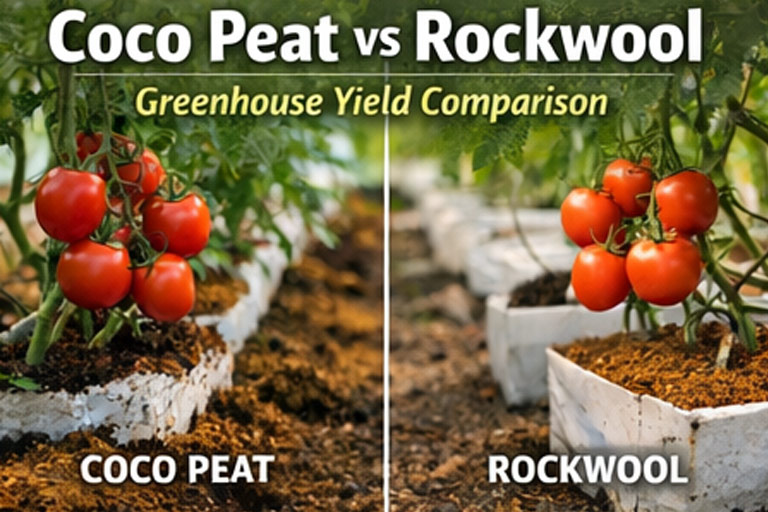
Coco Peat vs Rockwool – Greenhouse Yield Comparison
Coco Peat vs Rockwool – Greenhouse Yield Comparison isn’t just a technical debate; it’s a daily decision that affects yield curves, root behavior, and even how calm your greenhouse feels during peak season. Growers in Japan, South Korea, the USA, Canada, and beyond often ask the same quiet question: Which medium actually works with plants instead of fighting them? Here’s the thing—both substrates can grow crops. But how they behave under pressure? That’s where the difference shows up.
When Roots Start Talking, Growers Listen
Let me explain something growers don’t always say out loud. Roots tell you everything—if you pay attention. Rockwool gives fast, uniform starts. It’s clean. Predictable. Almost clinical. But coco peat behaves more like soil’s smarter cousin. It breathes. It holds moisture without drowning roots. That balance changes how plants respond during heat spikes or irrigation slips. Many commercial tomato and capsicum growers using cocopeat blocks notice roots spreading naturally rather than stacking vertically. That matters when plants are loaded with fruit. (You can see how processed coco substrates are structured on the Cocopeat page—worth a look if consistency matters to you.)
Yield Isn’t Just Numbers—It’s Stability
Yield charts look nice, but real farming happens between those data points.
In side-by-side greenhouse trials, coco peat often delivers:
- More stable EC buffering
- Less root stress during irrigation changes
- Reduced midday wilt in hot zones
That stability becomes visible in crops like cucumber, melon, and leafy greens, especially in high-density systems using Coco Peat Grow Bags. Rockwool can match yields—but only when water and nutrients are managed tightly. Miss a step, and plants react fast. Coco peat tends to forgive small mistakes. Honestly, during peak harvest weeks, that forgiveness is gold.
Water Management: The Quiet Yield Multiplier
Coco Peat vs Rockwool – Greenhouse Yield Comparison, When we Here’s a mild contradiction: rockwool drains fast, yet coco peat often uses less water overall. Why? Coco peat holds moisture inside its fiber structure while still releasing excess water. Roots drink when they want, not when you force them to. For berry and tomato growers in Mexico and Dubai, this trait alone changes irrigation strategy. According to background material on Coir, the fiber’s capillary action explains why coco-based media stays evenly moist without turning anaerobic. Cost Over Time Feels Different Rockwool looks efficient on paper. Coco peat feels efficient in practice. Growers sourcing export-grade coco peat from Sri Lanka—particularly from processing zones around Negombo—often reuse the medium across multiple cycles after proper treatment. Rockwool? Disposal becomes part of the cost conversation, especially in Europe and Canada. This is where coir geotextiles and erosion-control byproducts quietly add value across the same supply chain. (You’ll find related materials under Erosion Control Products.)
Crop-Specific Reactions You Can’t Ignore
Tomatoes and bell peppers react differently than leafy greens. That’s not theory—it’s field behavior.
- Tomato & Capsicum: Coco peat supports thicker root crowns
- Cucumber & Melon: Less stress during rapid vegetative growth
- Leafy Greens: More uniform leaf size under variable climates
Some Japanese growers pair coco peat with husk fractions like Husk Chip Briquettes to fine-tune air porosity. It’s a small tweak, but plants notice.
Sustainability Isn’t a Marketing Word Anymore
You know what? Buyers now ask where media comes from. Not just how it performs. Coco peat—derived from coconut husk, a renewable agricultural byproduct—aligns naturally with sustainability programs. Background context on Coconut production explains why coir-based materials fit circular agriculture models better than mineral-based substrates. This matters in export-driven markets like the Netherlands and Japan, where documentation follows the crop.
So… Which One Wins?
There’s no dramatic winner. But there is a clearer fit. Rockwool suits tightly controlled, high-tech systems with zero margin for error. Coco peat suits commercial growers who want resilience, yield consistency, and calmer crop management across seasons. And when yields stay steady, stress stays low. That’s not data—it’s lived experience.
FAQs
- Does coco peat really outperform rockwool in yield?
Yield can be similar, but coco peat often delivers more stable results across varying conditions. - Is coco peat suitable for high-tech hydroponic systems?
Yes, especially when EC and irrigation schedules are adjusted to fiber-based behavior. - Which crops benefit most from coco peat?
Tomato, capsicum, cucumber, melon, and berries respond particularly well. - Can coco peat be reused?
With proper treatment, many growers reuse it for multiple cycles. - Is coco peat accepted in Japan and the USA?
Yes—export-quality coco peat from Sri Lanka is widely used in both markets.